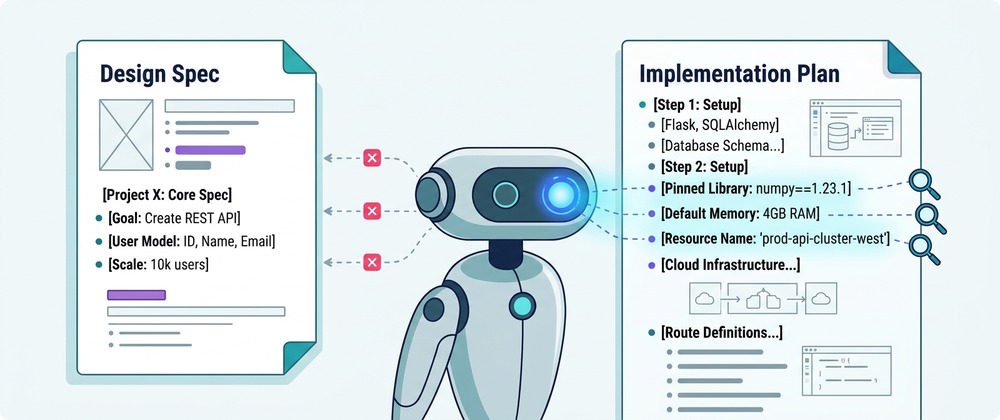

In my agentic software development workflow article, I said that the spec was the only human gate: I approve the spec, the plan derives from it, and I let the agents build without reading the plan. That was how Superpowers worked back then, but since v6.4.1 it asks you to review the plan too before anything runs.
I still don’t read my plans, though. Instead, I added a new read-only agent to my workflow that reads the plan for me, compares it with the spec, and gives me a short list with every decision the plan made that I didn’t. Today I’ll show you why a plan can drift away from its spec, how this agent works, and what I do with its report. If you read my previous articles about adversarial reviews and enforcing TDD with hooks, you’ll see it follows the same idea. Let’s dive in!
What changed in Superpowers
Two releases in September changed how Superpowers treats plans:
- v6.4.1 turned the plan into a human gate: “You review the saved plan before anything runs. Approving an idea or a scope no longer counts as approving a plan you haven’t seen.” It also added a Review Focus section to the plans, with the inputs or failure modes the spec implies but no test covers.
- v6.4.2 made plans leaner. A plan now “records decisions. It’s not a transcript of the code.” So instead of writing out every function, each step gives the signature, the file, the test assertions, and the values from the spec.
Plans used to be huge (a thousand lines for complex work wasn’t rare), and they weren’t intended to be human-reviewed, as I already explained in my agentic workflow. Now they are shorter and made of decisions, so reviewing a plan basically means checking each of those decisions against the spec. And that’s something an agent can help me with. Not to replace the human review, but to assist me focusing on what was not in the approved spec.
Where a plan drifts from the spec
To turn the spec into concrete steps, the agent writing the plan needs concrete values, and many of them are not in the spec. In my homelab repository, the usual ones are:
- A specific version of a library, a tool or a Helm chart.
- Sensible defaults, like the CPU and memory requests in the service templates.
- Names, like the name of a PVC.
- Some odd edge case that we didn’t evaluate during the brainstorming.
Most of them are fine choices, but nobody approved them, and they never got into the spec. Depending on the project, there are usually 3 to 5 of them per plan, and up to 20 when the plan is big enough.
The writing-plans skill ends with a self-review, but it can’t catch these. The session that wrote the plan is the same one that wrote the spec, so it remembers every decision we discussed during the conversation. When it reads the plan, it can’t tell which decisions are in the spec and which ones only live in its context. It’s the same anchoring problem I described in why your AI agent shouldn’t review its own code: the author reads the plan with the whole conversation in mind.
The plan reviewer agent
What I needed was a reader that has nothing but the documents. That’s sp-plan-reviewer, a custom Claude Code subagent that runs on Opus and can’t edit anything (its tools are Read, Grep and Glob). When it gets dispatched, its prompt carries just two paths, the spec and the plan, with no summary of the design discussion and no hints about what I expect it to find.
The core of its prompt is this question:
Flag everything the plan does, decides, creates, changes, or pins that is not
recorded in the spec. This includes new files, names, values, commands,
procedures, ordering, or behaviour the spec does not state or clearly imply.
Then, each finding goes into one of three categories:
- (a) a direct, unambiguous consequence of something the spec says.
- (b) something already established elsewhere in the repository (it must cite where:
CLAUDE.md, an ADR, existing code, etc). - (c) a new decision that only the plan makes.
Before settling on (c), the agent must search the repository, so a chart version that is already pinned for another service ends up as (b) instead of as noise. On top of that, it also reports contradictions between the plan and the spec, and gaps (spec requirements the plan doesn’t implement). The report puts (c) first, then contradictions, then gaps, which keeps the part I care about always at the top.
What happens with the report
The report goes back to the session that wrote the plan, which triages it with one strict rule: it never edits the spec on its own. Gaps and contradictions are fixed in the plan, because the spec always wins. And every (c) finding comes to me, together with the list of fixes it already made. For each one, I decide if it moves into the spec (I agree with the decision, so now it’s recorded) or if it comes out of the plan.
As with the rest of my Superpowers tweaks, I wired it with a rule in my user-scope CLAUDE.md (no hook this time, unlike the TDD guard):
Reviewing plans. After the
superpowers:writing-plansself-review and before the execution handoff, dispatchsp-plan-revieweronce. The dispatch prompt is the spec path and the plan path, nothing else. (…) Triage the report: add missing spec requirements to the plan, and where plan and spec contradict, change the plan to match the spec. Never edit the spec on your own. Bring every category (c) finding, and any fix that would touch the spec, to your human partner. (…)
You can check the full CLAUDE.md rule and the sp-plan-reviewer agent in GitHub Gists.
In the end, reviewing a plan for me means reading a handful of findings, and after that, the spec records every decision the code is going to be built on. That’s why I think my claim from June still holds, more or less: the spec is still the only contract I approve, and the reviewer makes sure the plan stays inside it.
Wrapping up
With this setup I still don’t read my plans, but nothing gets built on a decision I never approved. Its main caveat is that the reviewer only checks the plan against the spec: If the spec is wrong, the plan will be wrong too. So the spec is the most important gate, and I take special care to ensure its correctness before approving it.
Happy coding!